Within Private Markets, there is a term that circulates very often called Dry Powder. I thought it would be beneficial to highlight what it means and when it is used, so let’s start by providing a bit of context.
In Private Markets, we have two sides of the market:
- LPs called Limited Partners
- GPs called General Partners
LPs are the investors who commit capital to a fund, while GPs are the fund managers who deploy that capital into investments.
When a GP starts a new fund, it drafts a governing document called the Limited Partnership Agreement (LPA). The LPA defines the terms of capital calls, including the notice period, timing, governance, reporting, management fee structure, and conditions under which the GP can call committed capital from LPs during the investment period that typically lasts from three to five years from the date of its first closing.
The GP makes capital calls on committed capital over the fund’s investment lifecycle, as these funds are not provided on day one. An LP’s committed capital is a legally binding promise to provide a certain amount of money to the fund when the GP calls for it, not actual capital invested in the fund.
An LP has the responsibility to meet capital calls within a short period of time, usually between one and two weeks. If an LP fails to meet a capital call on time, the GP might charge high interest rates on late payments or even force a sale of the LP’s interest on the secondary market, where investors buy and sell pre-existing commitments to funds.
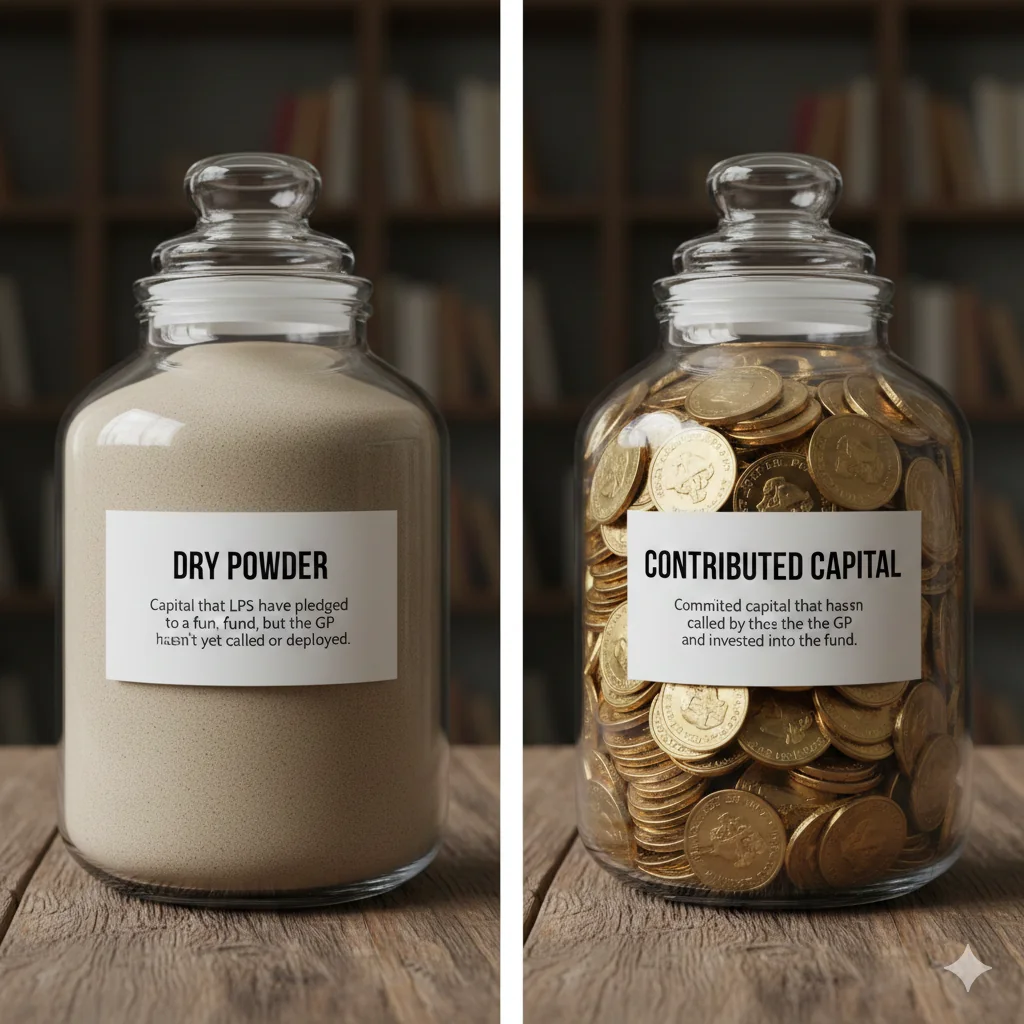
An LP’s committed capital that has already been called by the GP and invested into the fund is known as contributed capital. On the other side, the uninvested committed capital is known as dry powder, which is capital that LPs have pledged to a fund, but the GP hasn’t yet called or deployed. It’s essentially money sitting on the sidelines, waiting to be invested in deals.
For example, if a PE fund raised $1 million in commitments and has so far called and invested $300 thousand, the remaining $700 thousand is dry powder.
High levels of dry powder might indicate that the GP is struggling to find attractive deals at reasonable valuations. It can also be seen positively, as capital ready to be put to work when opportunities arise, such as during market downturns, waiting for attractive M&A opportunities or spin-offs.
The concern only arises when dry powder accumulates over an extended period, because LPs are paying management fees on committed capital, meaning they are effectively paying fees on capital that hasn’t been called or put to work yet.